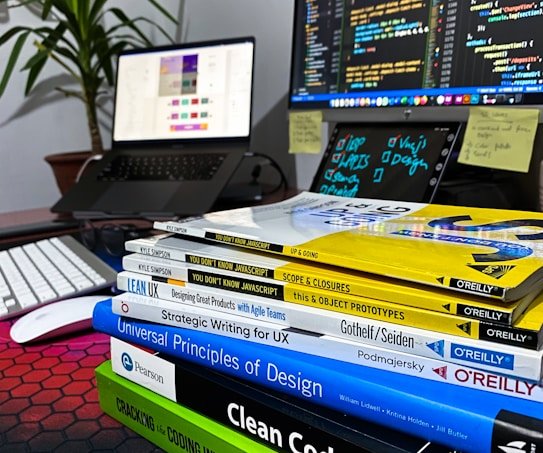
Platforms like Coursera, edX, and Udemy offer world-class structures, but completion rates hover below 10%.
- The Pitfall: Treating a MOOC like a Netflix show—bingeing lectures without doing the assignments.
- The Deliberate Shift: Treat it like a university class you paid thousands for. Block out immovable time in your calendar, participate in the student forums, and aggressively tackle the optional projects.
The Digital Credential: How to Build a University-Grade Education Using MOOCs
The traditional promise of higher education is fracturing. For decades, the path to a high-paying career required spending tens—or hundreds—of taxpayers’ Here is the practical, easy-to-understand roadmap for applying a deliberate learner approach to building a university-grade education using free MOOC audits.
1. The Strategy: The Free “Audit” Arbitrage
Most people treat online courses like TV. To learn deliberately, use the Audit button as a free, high-speed vetting tool.
- Skills Over Certificates: Employers hire for proof of capability, not basic completion badges. Auditing gives you free access to elite lectures and readings. Save your money for building real things.
- The Free Trial Architecture: Enroll in 2 or 3 competing courses on the same topic at the same time. Watch the first hour of each, keep the one with the best teacher, and drop the rest immediately.
2. The Structure: The Unbundled Degree Blueprint
Do not take random courses. Reverse-engineer a top-tier university syllabus to design a structured, step-by-step curriculum.
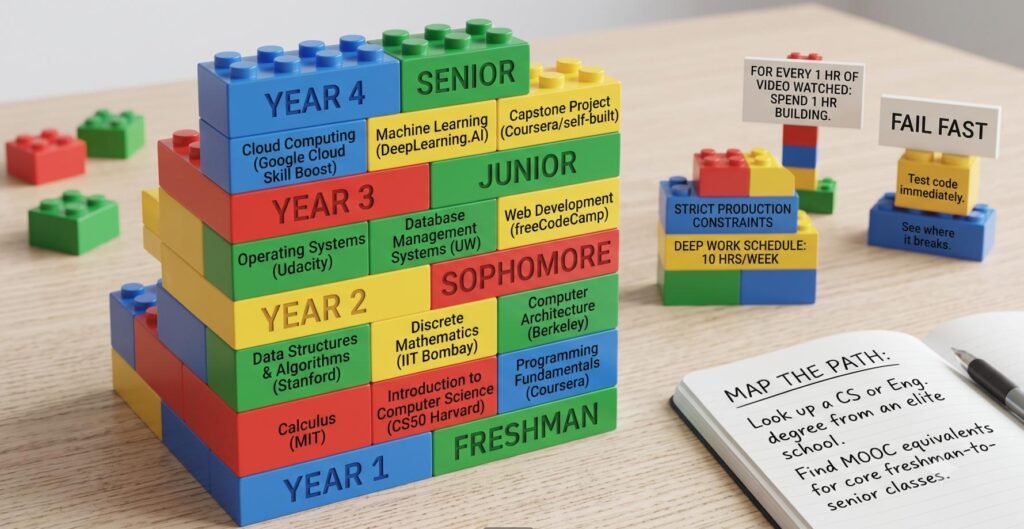
The 2-Step Execution:
- Map the Path: Look up a computer science or engineering degree requirements at an elite school. Find the exact MOOC equivalents for their core freshman-to-senior classes.
- Set Strict Production Constraints: Set a 10-hour-per-week deep work schedule. For every 1 hour of video you watch, you must spend 1 hour building. Fail fast: Test your code or designs immediately to see where they break down.
3. The Execution: Engineering Your Own Feedback Loops
The main downside of auditing for free is the lack of official grading. You must create your own feedback mechanisms to catch mistakes early.
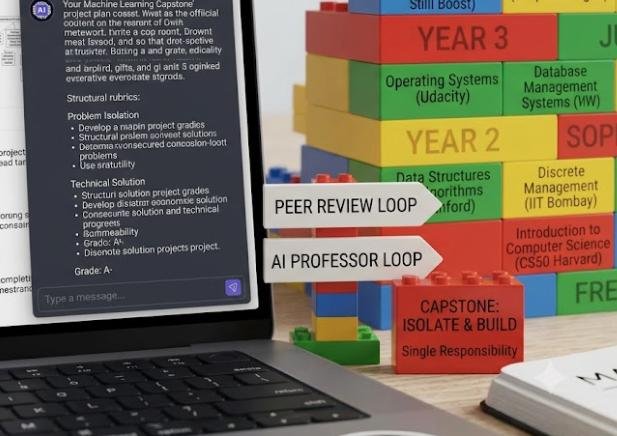
- Peer Reviews: Post your un-graded work in the course discussion forums. Ask advanced students for specific, targeted critiques.
- The AI Professor Loop: Treat generative AI as a strict teaching assistant to get immediate, low-stakes feedback. Use this exact prompt:
“I am auditing a university-level course on [Topic]. Here is the official assignment prompt: [Insert Prompt]. Here is my work: [Insert Your Work]. Act as a strict university professor. Critique my work, identify any logical gaps, and grade it against standard academic rubrics.”
4. The Proof: The Capstone Portfolio
A diploma is just a proxy for competence. When you audit for free, your public portfolio must provide undeniable proof of your skills.
Document Publicly: Clean, public code on GitHub or deep technical write-ups prove self-motivation and root-cause problem-solving skills that a standard piece of paper cannot match.
Isolate and Build: Do not build generic class tutorials. Pull down a real-world dataset, build an encrypted vault, or design a complete application from scratch.
Single Responsibility: Ensure every project in your portfolio solves one specific, complex problem cleanly and efficiently.